
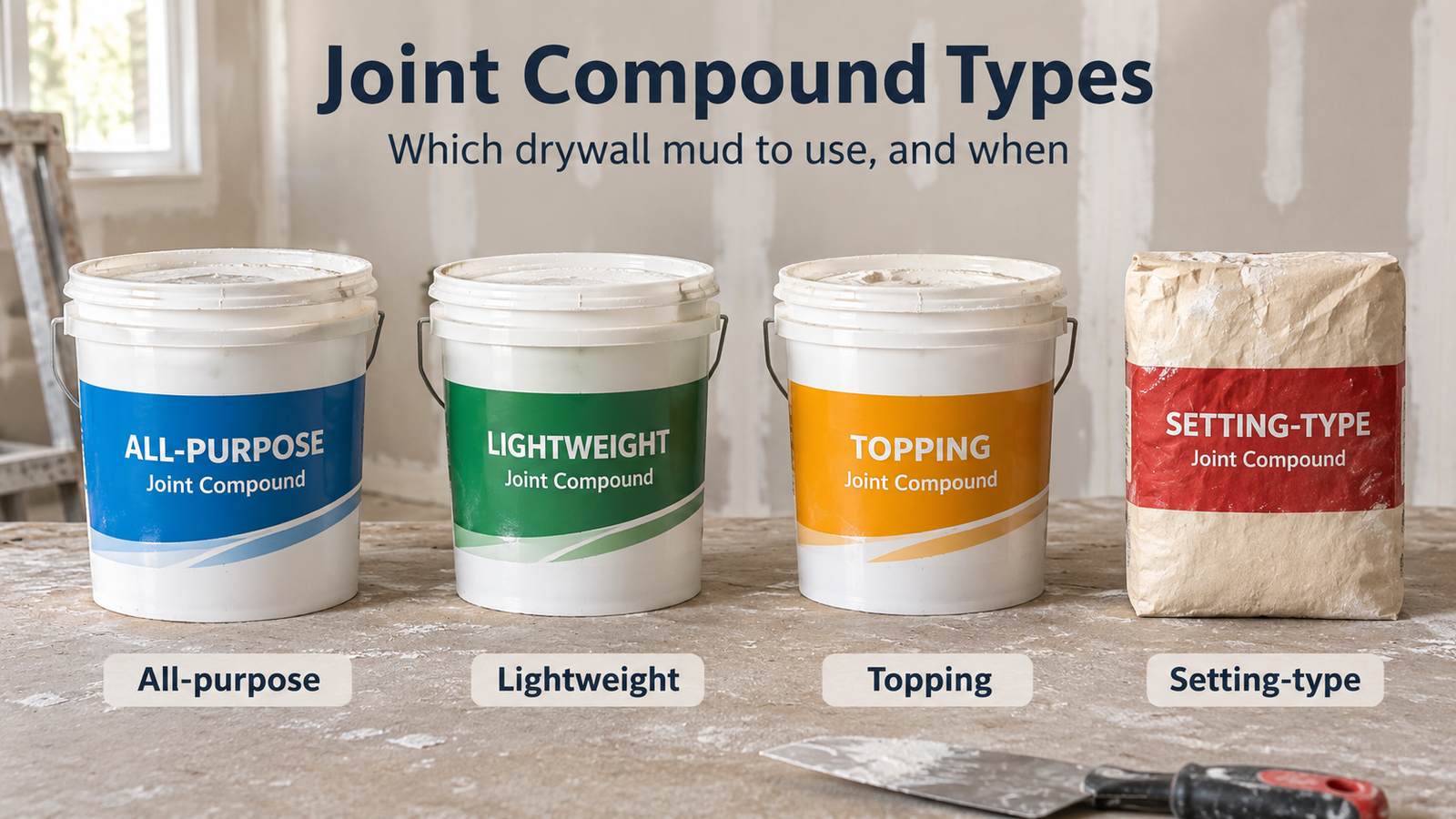
Quick answer: The main joint compound types are all-purpose, lightweight, setting-type (hot mud) and topping. Use all-purpose for taping and general work, lightweight for fill and finish coats because it sands easily, and setting-type for fast, hard-setting repairs, deep fills and the first coat over mesh tape. Check the label before using lightweight compound with mesh tape.
Walk into any hardware store and you’ll find a wall of buckets and bags that all say joint compound. They are not the same. The joint compound types behave very differently, and the wrong one is how you end up with cracked tape, mud that fights your sander, or a patch that stays soft for days.
Here is what each type is for, how long it takes to dry or set, and which one to grab for taping, patching, bathrooms and skim coating, so you can buy the right one the first time.
Joint compound at a glance
| Type | Best for | Dry or set time | Sanding | Shrinkage | Good with mesh tape? |
| All-purpose (premixed) | Taping and every coat | Dries by evaporation, up to about 24 hours per coat | Moderate | Moderate | Check the label; setting-type is the safer first coat |
| Lightweight all-purpose | Fill and finish coats, small repairs | Dries by evaporation, about a day per coat | Easy | Low | Often not recommended; some makers say no |
| Topping | Final coats only | Dries by evaporation, about a day per coat | Easiest | Lowest | No |
| Setting-type (hot mud) | First coat over mesh tape, deep fills, fast repairs | Sets in 5 to 210 minutes, depending on the type | Hard (lightweight versions sand easier) | Very low | Yes, the usual choice |
Times depend on how thick you apply it, the temperature and the humidity. Always follow the label on your product.
All-purpose joint compound
This is the default bucket. All-purpose compound can be used for every coat, from embedding the tape to the final skim. It bonds strongly, which is why many finishers still use it to bed paper tape.
The trade-offs are weight and sanding. It is heavier than the newer lightweight formulas, it shrinks more as it dries, and it takes more effort to sand. Many pros bed the tape with regular all-purpose, then switch to a lighter compound for the fill and finish coats.
You may also see taping compound. It is a stronger, more adhesive version meant for embedding paper tape and often harder to sand, so it is not meant for the final coats.
Best for: embedding paper tape, filling screw holes, general-purpose work.
Lightweight joint compound (and how it compares with all-purpose)
Lightweight compound is made with lighter ingredients and weighs roughly 25 to 30 percent less than conventional compound. In practice that means it spreads more smoothly, shrinks less and sands much more easily.
All-purpose vs lightweight joint compound in one look:
- Bond strength: all-purpose is a bit stronger for embedding tape.
- Sanding: lightweight is far easier.
- Shrinkage: lightweight shrinks less.
- Weight: lightweight is lighter to carry and spread.
- Surface: lightweight is softer and scratches more easily, so prime it soon after sanding.
The catch is tape. Some manufacturers say their lightweight compound is not recommended for embedding fiberglass mesh tape, so read the label before you use it for the first coat. For fill and finish coats, it is hard to beat.
Best for: second and third coats, small repairs, anywhere you want less sanding.
What is hot mud? Setting-type joint compound (5, 20, 45 and 90 minute)
Hot mud is the nickname for setting-type joint compound. It comes as a powder that you mix with water. Instead of drying by evaporation, it hardens through a chemical reaction, so it sets on a schedule no matter how humid the room is.
The numbers on the bag (5, 20, 45, 90 and 210 minutes) are the working time before it starts to set. Choose the one that fits the job:
- 5 minutes: tiny, quick fixes.
- 20 minutes: small patches and a fast first coat.
- 45 or 90 minutes: taping a room or deeper fills. Beginners are usually happier with the longer working time.
- 210 minutes: large jobs where you need time to work.
Why people like it: it is strong, shrinks very little even in deep fills, and lets you do a coat and recoat the same day. It is also the type manufacturers recommend for the first coat over fiberglass mesh tape. Lightweight versions, such as USG Sheetrock Easy Sand, sand far more easily than traditional hot mud.
Watch out for:
- It is hard to sand once fully cured. Many finishers knock off ridges with a knife while it is still setting.
- Keep tools and buckets very clean, since old residue can make it set early.
- Mix only what you can use in the working time, and never add water to mud that has started to set.
- Don’t use it for thin skim coats. If it dries before it sets, the bond can fail.
- It works at temperatures down to about 45 degrees Fahrenheit.
Topping compound
Topping compound is made for the last coat. It is soft, smooth and easy to spread and sand, shrinks less than all-purpose, and can weigh up to about 35 percent less. It is not strong enough for embedding tape, so don’t use it for the first coat.
Many DIYers skip topping compound and use lightweight all-purpose for the finish coat, which works well. If you want the smoothest possible final coat, topping compound is worth a look.
Premixed vs powder joint compound
Both all-purpose and topping compounds come premixed or as a powder. Used properly, they give the same final results. Setting-type compound is always powder.
| Premixed (bucket or box) | Powder (bag) | |
| Convenience | Ready to use; just stir | You mix it with water |
| Consistency | Set by the maker | You control it, but lumps are possible |
| Storage | Keep it sealed and covered | Unopened bags keep well; follow the label |
| Best for | Most DIY taping and finishing | Setting-type jobs and large amounts |
Once a premixed bucket is open, it does not last forever. See how long drywall mud lasts after opening.
Which joint compound for which coat?
| Coat | Paper tape | Mesh tape |
| Tape coat (embeds the tape) | All-purpose or taping compound | Setting-type (20, 45 or 90 minute) |
| Fill coat (covers the tape) | Lightweight or all-purpose | Lightweight or all-purpose |
| Finish coat (last, smooth coat) | Lightweight or topping | Lightweight or topping |
Most joints need three coats. For how many you need and how long to wait, read how many coats of drywall mud before sanding and how to dry drywall mud faster. The full process is in our guide to taping drywall joints and mudding with mesh tape.
Best joint compound for beginners, patches, bathrooms and skim coating
For beginners
The forgiving combination is a premixed lightweight all-purpose for the fill and finish coats, plus a small bag of 45 or 90 minute setting-type for the first coat if you use mesh tape. If you use paper tape, regular all-purpose is a good choice to embed it. This keeps sanding easy and the tape strong.
For patches and repairs
Use setting-type (20 or 45 minute) for the first coat on deep holes or wide gaps, since it barely shrinks. Finish with lightweight compound. See how to patch a hole in drywall and how to fix nail pops in drywall.
For bathrooms and humid rooms
Setting-type is a sensible pick because it does not rely on evaporation to harden. Keep in mind that no joint compound is waterproof. Behind tile in a shower, use cement board, not mud. For other humid rooms, see whether regular drywall mud works in a bathroom.
For skim coating
Use a drying compound (all-purpose, lightweight or topping) thinned as the label allows. Avoid setting-type for thin skim coats. Our skim coat guide covers the technique.
How much to buy
A common rule of thumb is roughly 9 to 10 gallons of premixed compound per 1,000 square feet of drywall, though it varies with finish level and how thick you apply it. Use our drywall calculator to size the job and read about finish levels.
Products worth a look
Disclosure: This post contains affiliate links. If you buy through them, I may earn a commission at no extra cost to you.
- Premixed all-purpose: USG Sheetrock Brand All Purpose Joint Compound
- Lightweight, lower dust: USG Sheetrock Brand Dust Control Joint Compound
- Setting-type (hot mud): USG Sheetrock Brand Easy Sand in 20, 45 or 90 minutes
- Topping: a lightweight topping compound such as Beadex Topping Lite
- Tools: 6, 10 and 12-inch taping knives, a mud pan, and a sanding sponge
Can you mix different types of joint compound?
You can use different types in different coats, and many pros do. A common approach is setting-type for the first coat and a drying compound for the thinner finish coats.
Don’t mix different compounds together in the same bucket, and don’t add other products to a setting-type mix. Going the other way, putting setting-type over a drying compound, can cause bonding problems, so follow the manufacturer’s instructions.
Also let each coat cure fully before the next one. If you rush, see how to fix a bad mud job.
FAQs
What is the difference between all-purpose and lightweight joint compound?
All-purpose bonds more strongly and works for every coat, including embedding tape. Lightweight weighs roughly 25 to 30 percent less, shrinks less and sands much more easily, but its bond is slightly weaker, so it suits fill and finish coats best.
What is hot mud?
Hot mud is the nickname for setting-type joint compound. It is a powder you mix with water that hardens by a chemical reaction in 5 to 210 minutes, depending on the type, instead of drying by evaporation.
Can you use lightweight joint compound with mesh tape?
Usually not for the first coat. Some makers say their lightweight compound is not recommended for embedding mesh tape, and manufacturers recommend setting-type for that coat. Check the label of your product.
Which joint compound is best for beginners?
A premixed lightweight all-purpose is easiest for fill and finish coats. For the first coat, use all-purpose with paper tape, or a 45 or 90 minute setting-type with mesh tape.
Can you use joint compound for skim coating?
Yes, a drying compound works well for skim coating. Don’t use setting-type for thin skim coats, because it can fail to bond if it dries before it sets.
How long does joint compound take to dry?
Drying types can take up to about 24 hours per coat, longer in thick coats or humid rooms. Setting-type hardens in 5 to 210 minutes, depending on the product you choose.
Quick recap
- All-purpose for taping, lightweight for fill and finish, topping for the last coat if you want it.
- Setting-type (hot mud) for mesh tape’s first coat, deep fills and fast repairs.
- Check the label, especially before using lightweight with mesh tape.
- Thin coats, full cure between coats, then sand lightly and prime.