
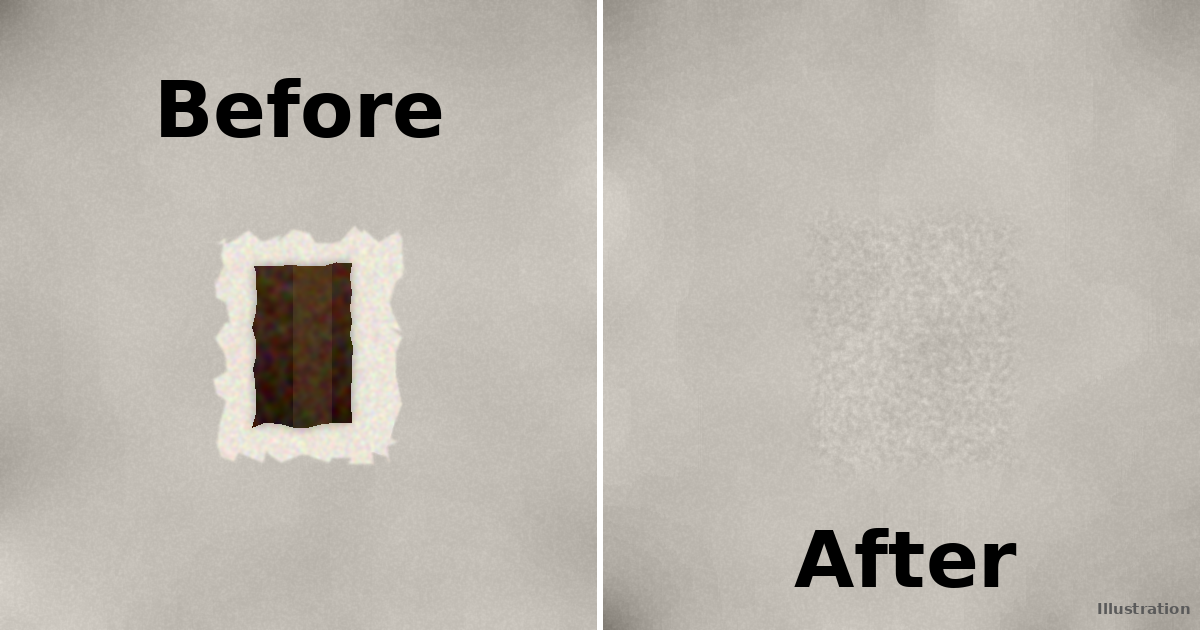
Quick answer: To patch a hole in drywall, match the repair to the hole size. Small holes need only spackle or joint compound. Doorknob-size holes need a mesh or metal-backed patch. Holes larger than about 6 inches need a cut-in drywall piece fastened to backing. Always finish with two thin coats, sand, prime, and then paint.
Somebody opened a door too hard. A TV mount let go. A chair got dragged where it shouldn’t have been. However it happened, you now have a hole in your drywall, and you would like it gone without paying someone to spend half a day on it.
Good news: learning how to patch a hole in drywall is one of the easiest repairs in a house. The method depends almost entirely on how big the hole is. Below you’ll find what to do for every size, from a nail hole to a hole you could put your head through. You’ll also see how to patch without a kit, how to handle a ceiling, and how to make the repair disappear once it’s painted. That last part is where most DIY patches fail.
What size is your drywall hole? Pick your repair
Measure the hole at its widest point. If the edges are crumbly or soft, measure the damaged area, not just the opening.
| Hole size | Typical cause | Best repair | Hands-on time | Total time with drying | DIY cost |
| Under 1/4 inch | Nails, screws, push pins | Spackle or joint compound | 10 minutes | 1 to 2 hours | Under $10 |
| 1/4 to 1/2 inch | Anchors, dings, dents | Two coats of lightweight spackle or compound | 20 minutes | Half a day | Under $15 |
| 1/2 to about 6 inches | Doorknobs, fists, furniture | Self-adhesive mesh or metal-backed patch plus 2 to 3 coats of compound | 45 to 60 minutes | 1 to 2 days | $15 to $30 |
| 6 inches to about 2 feet | Water damage, removed fixtures, accidents | Cut-in drywall patch with backing, tape and 3 coats | 1 to 2 hours | 2 days | $20 to $50 |
| Larger than 2 feet, or crossing studs | Major damage, wet drywall | Replace the section, or hire a pro | Varies | Varies | See the cost section |
The costs and times are estimates for a typical home. Drying depends on humidity and how thick you apply the compound.
Tools and materials
For every repair
- A 6-inch drywall knife (a 2-inch putty knife is fine for tiny holes)
- A 10 or 12-inch drywall knife for wider finishing coats
- Lightweight spackle or all-purpose joint compound
- Fine sandpaper or a sanding sponge, 120 to 220 grit (see our sandpaper grit guide)
- A damp sponge and a clean rag
- Primer and matching paint
- Safety glasses and an N95 dust mask
For medium and large holes
- A self-adhesive mesh patch or a metal-backed patch (4 x 4 or 6 x 6 inches covers most doorknob holes)
- A utility knife and a drywall saw (a jab saw works)
- A scrap of drywall the same thickness as your wall (most walls are 1/2 inch)
- Wood strips (1×3 furring or similar) for backing, plus 1-1/4 inch drywall screws
- Mesh or paper drywall tape
- A drill or screw gun, tape measure, and pencil
- A stud finder, ideally one that detects live wires
Quick safety check before you cut anything bigger than a thumb
- If the hole is near an outlet, switch or light, turn off the breaker for that circuit first.
- Shine a flashlight inside and look for wires, pipes, and insulation before you cut.
- If your home was built before the 1980s and you aren’t sure what’s in the old joint compound or texture, get it tested before sanding. Some older products contained asbestos.
- If the hole came from a leak, the wall may be wet or moldy inside. Fix the leak first, then patch. See our guide on repairing drywall around pipes and fixtures.
How to patch a small hole in drywall (under 1/2 inch)
Nail holes and small dings are the easy ones. You don’t need tape or a patch.
- Clean up the edges. Scrape off any raised bits or loose paper with your putty knife so the area is flat.
- Fill the hole. Load a bit of spackle or compound on the knife, press it firmly into the hole, then scrape across it to leave a smooth surface. Overfill slightly, because it shrinks as it dries.
- Let it dry. Spackle often dries in 30 minutes to a couple of hours. Check the label, since lightweight formulas vary.
- Add a second coat if it sank. A shallow dip is normal. Fill it again and let it dry.
- Sand lightly. Use 120 to 220 grit until the patch feels flush with the wall. Wipe off the dust.
- Prime and paint. Prime the spot, then paint.
How to patch a doorknob hole in drywall (self-adhesive mesh patch)
This is the most common wall hole in any house, and a mesh patch handles it well. A doorknob hole is usually 2 to 3 inches across, so a 4 x 4 or 6 x 6 inch patch covers it.
- Trim the damage. Cut away loose paper and broken gypsum with a utility knife. Press in any bulging edges. You want a clean, solid edge.
- Wipe the wall. The patch sticks only to a clean, dry surface. Brush or wipe away dust around the hole.
- Place the patch. Peel the backing and center the patch over the hole with at least 1 to 2 inches of overlap on every side. Press the edges flat so no air pockets remain. For a harder hit, use a metal-backed patch instead; it holds its shape better.
- Apply the first coat. Use a 6-inch knife to press compound through the mesh and over it, extending 1 to 2 inches past the edges of the patch. Scrape it tight. If you want to do a second coat the same day, use a 20 or 45 minute setting-type compound for this first coat.
- Apply the second coat. After the first coat is fully dry, use a 10-inch knife and spread a thin layer that reaches a couple of inches wider than before. Lightly feather the edges so they blend into the wall.
- Apply a third thin coat if needed. Most patches need two or three. Don’t try to fill everything in one thick coat. It cracks and takes forever to dry.
- Sand, prime and paint. Sand smooth, wipe off the dust, prime the whole patch, then paint.
Tip: Between coats, run your hand over the patch with your eyes closed. You’ll feel ridges and bumps that your eyes miss.
How to patch a large hole in drywall (cut-in patch with backing)
For holes bigger than about 6 inches, a mesh patch won’t be strong enough. You’ll need to cut a clean opening, add backing, and install a new piece of drywall. It sounds harder than it is.
- Check behind the wall. Shine a flashlight in. Look for wires, pipes and insulation. Turn off power if there’s any chance of wiring.
- Cut a clean opening. Use a utility knife or jab saw to turn the ragged hole into a neat square or rectangle. Straight edges are much easier to fit a patch into. If the opening reaches a stud, you can screw the patch straight into it.
- Add backing. Cut two wood strips about 4 inches longer than the opening. Slide one behind the hole along the top edge and one along the bottom. Hold each in place by driving two screws through the existing drywall into the strip, so half of it is behind the wall and half is exposed in the opening for the patch. (Drywall repair clips are a handy alternative.
- Cut the patch. Use a scrap of drywall of the same thickness. Cut it about 1/8 inch smaller than the opening on every side so it drops in easily.
- Screw it in. Fasten the patch to the backing with drywall screws, sinking each one just below the surface without tearing the paper.
- Tape the seams. Cover the gap around the patch with mesh or paper tape.
- Mud in three thin coats. Coat one embeds the tape (6-inch knife). Coat two goes on after it dries (10-inch knife). Coat three is the final feathered coat (12-inch knife). Let each coat dry fully.
- Sand, prime and paint.
If the damage is bigger than about 2 feet or crosses several studs, it may be quicker to replace the whole section. Our guide on whether to repair or replace drywall will help you decide.
How to patch a hole in drywall without a patch kit
No kit and no trip to the store? You can do it with a scrap of drywall. Here are two methods.
Method 1: The paper-flange patch (often called a California patch)
This works for holes up to about 6 inches.
- Cut the hole into a clean square or rectangle.
- Cut a scrap piece of drywall about 2 inches bigger than the hole on every side.
- Turn the scrap over and score a smaller square on the back, slightly larger than the hole, cutting through the gypsum but not through the front paper.
- Snap and peel off the gypsum around the edge so you’re left with a core piece that fits the hole, surrounded by a flap of paper about 1 to 2 inches wide.
- Spread compound around the hole, press the patch in, and smooth the paper flange flat against the wall.
- Coat over the flange with thin layers of compound, feathering out as you go. Sand, prime and paint.
Method 2: The scrap-wood bridge
This is good for medium holes when you have no mesh patch.
- Cut a piece of scrap wood a few inches longer than the hole is wide.
- Slide it behind the hole and screw it to the wall through the drywall on each side.
- Cut a drywall scrap to fit the opening and screw it to the wood.
- Tape the seams, then finish with three thin coats of compound. Sand, prime and paint.
What to skip: expanding foam and crumpled paper. They look like shortcuts but they’re hard to sand and they fail over time.
How to patch a hole in a drywall ceiling
The repair is the same as on a wall, with three differences: gravity, dust in your face, and texture.
- Use backing. It’s even more important overhead. A patch that isn’t well supported will sag or pop later.
- Use setting-type compound for the first coat. It sets quickly and doesn’t droop the way heavy wet compound can on a ceiling.
- Keep coats thin. Thick compound overhead slumps and cracks.
- Match the thickness. Ceilings are often 1/2 inch, but some are 5/8 inch. Measure the edge of the hole before you buy a scrap.
- Protect yourself. Wear safety glasses and a mask. A pole sander helps keep your arms down and the dust off your face.
- Check for a leak. If the hole is near a stain, the cause may be water. Fix the source, let it dry, and look for mold before you patch. Use a stain-blocking primer on any leftover mark.
If the ceiling is textured, plan on matching it (see the next section).
How to make a drywall patch invisible
A patch that’s solid but shows through the paint is the most common complaint. Four things fix it.
- Feather the edges. Each coat should be wider than the last, with the edges so thin you can barely see them. The goal is a gentle slope across about 10 to 12 inches, not a hump.
- Sand smart. Use 120 to 150 grit for shaping and 220 for a final pass, and keep your touch light. Over-sanding tears the paper face and leaves fuzz that shows through paint. Our sandpaper grit guide has the details.
- Prime the patch. Joint compound soaks up paint differently than the wall around it. This causes flashing, where the patch looks duller or shinier than the rest. A coat of primer evens it out. Skipping primer is the number one reason patches show up.
- Match the texture. For a smooth wall you’re done. For orange peel or knockdown, use a spray texture can and test it on cardboard first. For a rough or stipple texture, a roller with the right nap often works. Apply texture before priming.
Then paint with the same paint and sheen as the wall. Two coats, extending past the patch to a natural break such as a corner, will hide any slight difference. Before priming, hold a flashlight flat against the wall and look along it. It shows every ridge.
Need help getting the wall ready? Read our guide to preparing drywall for paint.
How much does it cost to patch drywall?
Doing it yourself is cheap. Hiring it out costs more, mostly because of the minimum charge.
| DIY | Hiring a pro | |
| Small hole | Under $10 | Often $100 or more, because many handymen have a minimum charge |
| Doorknob-size hole | $15 to $30 | Commonly $100 to $300 |
| Large hole or ceiling | $20 to $50 | Commonly $200 to $500 or more |
| What you pay for | Materials only; most can be reused | Labor, travel, repeat visits for drying and texture |
Angi’s cost guide puts professional drywall patching at roughly $300 to $900 for a typical job, with a national average around $580. A single small hole can cost less, and prices vary by region. Check current local rates before you decide.
When it’s worth hiring a pro:
- The damage is very large or crosses several studs.
- The drywall is wet, soft or moldy.
- The hole is near wiring you’re not comfortable working around.
- You need to match a complex texture across a large area.
Common mistakes
- Filling a big hole in one thick coat. It cracks, shrinks and takes days to dry. Use thin layers.
- Skipping the backing. A patch with nothing behind it will crack or sink.
- Using spackle for deep holes. It’s meant for shallow fills. Use compound for anything deeper.
- Using the wrong compound in wet rooms. See whether regular drywall mud works in a bathroom.
- Not feathering. Sharp edges make a bump you can see from across the room.
- Sanding too early or too hard. Wait until it’s fully dry, then go gently.
- Skipping primer. This is why patches flash through paint.
- Ignoring the cause. If the hole came from a leak, fix the leak. If a screw pulled out, find a stud.
- Forgetting the texture. A smooth patch on a textured wall is just as visible as a hole.
FAQs
How long does a drywall patch take to dry?
Spackle on a tiny hole can dry in 30 minutes to a few hours. Joint compound usually needs 12 to 24 hours per coat, longer in humid rooms. Setting-type compound hardens in 20 to 90 minutes, depending on the type. Most patches take one to two days from start to paint.
Can you use spackle on a big hole?
Not for anything deep. Spackle shrinks and cracks when it’s thick. For holes bigger than about 1/2 inch, use a mesh patch or drywall patch with joint compound in thin coats.
Why does my patch show through the paint?
The usual causes are skipped primer, edges that weren’t feathered, ridges from sanding, or a texture that doesn’t match. Prime the whole patch, feather wider, and match the texture and sheen.
What’s the best patch for a doorknob hole?
A self-adhesive mesh patch or a metal-backed patch, covered with two or three thin coats of joint compound. If the hole is bigger than about 6 inches, cut in a drywall patch with backing instead.
Do I need to prime before painting a patch?
Yes. Primer seals the patch so it takes paint the same way as the rest of the wall. Without it, the patch often looks dull or blotchy.
Can I patch a drywall hole without a kit?
Yes. Use a scrap of drywall with a paper flange, or a scrap-wood bridge with a drywall piece screwed to it. Finish with tape and thin coats of compound.
Quick recap
- Match the repair to the size: spackle, mesh patch, or cut-in patch.
- Thin coats beat thick ones every time.
- Feather wide, sand lightly, and always prime.
- Match the texture, then paint corner to corner if you can.
Got a hole this guide didn’t cover? Leave a comment with a photo description and what caused it, and I’ll point you in the right direction.