
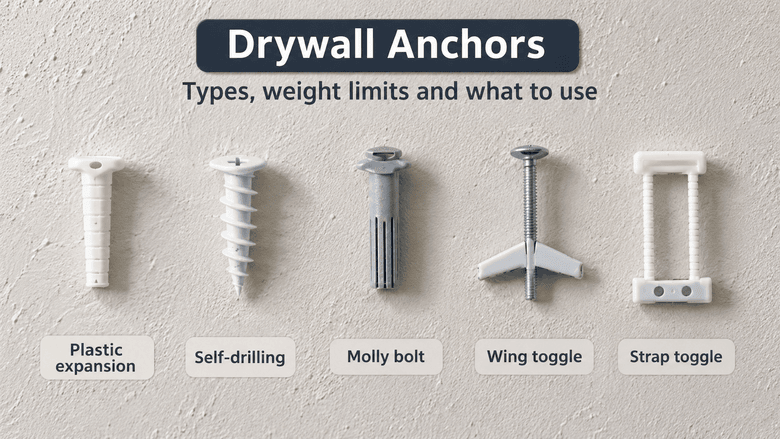
Quick answer: Use plastic drywall anchors for light frames, self-drilling anchors for medium loads, and toggle or molly bolts for heavy items. Anything heavy, including a TV, should go into a stud. Always follow the rating printed on the anchor package, which depends on the drywall thickness. A good rule is to plan on only about one quarter of an anchor’s ultimate (breaking) load.
Safety first: A falling TV, mirror or shelf can injure people. If you’re unsure, choose a stud or an anchor rated far above the item’s weight, and follow the manufacturer’s instructions for the product you’re mounting.
Drywall is a thin layer of gypsum between two sheets of paper. It’s great for walls and poor at holding things up. A screw driven straight into it pulls out easily, which is why you need an anchor or a stud.
This guide compares the main types of drywall anchors by weight rating and use. You’ll see what the numbers on the package really mean, which anchor suits a picture, shelf, mirror, curtain rod, TV or ceiling, how to install each one, and how to find a stud without a stud finder.
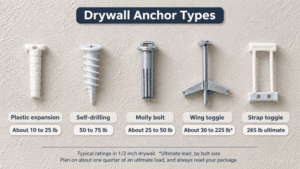
| Type | Typical rating | Hole size | Reusable? | Best for |
| Plastic expansion | About 10 to 25 lb | A small pilot hole sized to the anchor | No | Light frames, small decor |
| Self-drilling (threaded) | 50 or 75 lb on E-Z Ancor Twist-N-Lock packs | None; it screws in | Rarely | Mirrors, shelves, towel racks, curtain rods |
| Molly bolt (expansion sleeve) | Often roughly 25 to 50 lb; varies by size and brand | Matches the sleeve | The screw yes, the sleeve stays | Towel bars, medium shelves |
| Wing toggle (spring toggle) | About 30 to 225 lb ultimate, depending on bolt size (a 1/4 inch bolt is about 80 lb) | Large: about 3/4 inch for a 1/4 inch bolt | No; the wings drop inside the wall if you remove the bolt | Heavy items in hollow walls |
| Strap toggle (Toggler SnapToggle) | Ultimate 265 lb in 1/2 inch drywall (1/4-20 size) | 1/2 inch | Yes; the bolt can be removed and reinstalled | Heavy shelves, cabinets, heavy mirrors |
These are not the numbers to design your project around. Read the next section first.
How much weight can drywall hold on its own?
On its own, not much. The standard test for 1/2 inch drywall only requires it to resist about 77 pounds of nail pull, and that’s a lab test of how hard it is to pull a nail through the board, not a safe hanging load. In practice, a screw or nail driven only into drywall is fine for something very light, like a small lightweight frame, and nothing more.
The weight a wall can really hold comes from:
- A stud or joist. Solid wood or metal framing holds far more than the drywall does.
- An anchor that spreads the load behind the drywall.
Understand the numbers on the package
Anchor ratings differ a lot between sources, and here’s why:
- Ultimate vs working load. An ultimate load is the point where the anchor fails in a lab test. A working load has a safety margin built in. Manufacturers use both, and the package doesn’t always say which. Industry guidance, printed by manufacturers such as Toggler, is to use about one quarter of the ultimate load for anything you hang. A strap toggle with a 265 lb ultimate load is closer to a 66 lb working load.
- Per job, not per anchor. E-Z Ancor says its rating is per job, not per anchor. Using two 50 lb anchors does not mean you can hang 100 lb.
- Drywall thickness. Ratings are listed for 1/2 inch board. Toggler lists its 1/4-20 strap toggle at 265 lb in 1/2 inch drywall and 356 lb in 5/8 inch. Thinner board holds less.
- Shear vs pull-out. Shear is the downward pull along the wall, like a picture hanging flat. Pull-out (tension) is force straight out of the wall. Anything that sticks out from the wall, like a shelf or a TV arm, levers on the top anchors and creates a much bigger pull-out force than the item’s weight. Toggler’s own bulletin lists shear and tension separately, and they differ.
What independent testing found
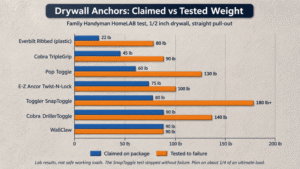
Family Handyman tested seven anchors in 1/2 inch drywall with a straight-pull setup. Every anchor met its claim, and most beat it:
| Anchor | Claimed | Tested |
| Everbilt Ribbed (plastic) | 22 lb | 80 lb |
| Cobra TripleGrip | 45 lb | 90 lb |
| Pop Toggle | 60 lb | 130 lb |
| E-Z Ancor Twist-N-Lock (medium duty) | 75 lb | 100 lb |
| Toggler SnapToggle | 80 lb | 180 lb (the test stopped without failure) |
| Cobra DrillerToggle | 90 lb | 140 lb |
| WallClaw | 90 lb | 90 lb |
That shows the ratings are conservative. Don’t treat the test numbers as your safe load, though. A lab pull in perfect drywall is not a wall with wobble, vibration, a leveraged shelf, or a bump from a child.
Which anchor for which job
A good rule: choose an anchor rated at least two to four times the weight of what you’re hanging, and put heavy things in studs.
| Job | What to use | Notes |
| Picture frame (light) | A hook and nail, or a small plastic anchor | Anchors are overkill for very light frames |
| Mirror | A self-drilling or molly anchor for lighter mirrors; a stud or strap toggle for heavy ones | Use two or more fastening points, spaced wide |
| Shelf | Studs first. If you can’t hit a stud, use strap toggles | A loaded shelf creates pull-out force on the top anchors |
| Curtain rod | Self-drilling or molly anchors, or a stud | Rods get tugged, so go one size heavier |
| Towel bar, grab bar | Molly or toggle anchors, or a stud | A grab bar must hold a person’s weight, so use a stud or the bar maker’s approved fasteners |
| TV | Studs. See the next section | Don’t use light anchors |
| Ceiling | Joists. Don’t hang heavy things from drywall | E-Z Ancor says its self-drilling anchors are not for ceilings. See what drywall to use on a ceiling. |
How to install each type of drywall anchor
Before you drill, check behind the wall for wiring and pipes. Avoid drilling straight above or below outlets and switches, because wires often run vertically from them. See how to avoid damaging wiring in a wall.
Plastic expansion anchors
- Mark the spot and drill a pilot hole that matches the size on the package.
- Tap the anchor in until it’s flush with the wall.
- Drive the screw through your fixture and into the anchor. Stop when snug.
Self-drilling (threaded) anchors
- Mark the spot.
- Screw the anchor into the drywall with a Phillips screwdriver (no pre-drilled hole), until the head is flush with the wall.
- Drive the screw through your fixture into the anchor. Don’t overtighten.
No drill? See how to install a drywall anchor without a drill.
Molly bolts
- Drill a hole that matches the sleeve size.
- Tap the molly in until its flange sits flush.
- Tighten the screw. The sleeve folds and grips the back of the drywall.
- Remove the screw, pass it through your fixture and tighten it again.
Wing toggle bolts
- Drill the larger hole the package calls for (about 3/4 inch for a 1/4 inch bolt).
- Thread the bolt through your fixture first, then onto the toggle.
- Fold the wings, push them through the hole, and pull the bolt back so they open behind the wall.
- Tighten. If you remove the bolt later, the wings fall inside the wall.
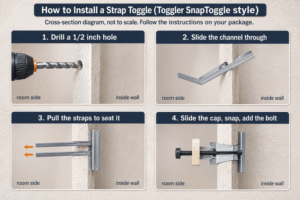
Strap toggles (Toggler SnapToggle)
- Drill a 1/2 inch hole for a 1/4-20 size.
- Slide the metal channel through the hole and pull on the straps so it sits flat behind the wall.
- Slide the plastic cap down the straps to the wall, then snap off the straps.
- Put the bolt through your fixture and tighten it into the channel.
Anchor spinning in the hole? See how to fix a spinning drywall anchor.
How to find studs without a stud finder
Studs are usually 16 inches apart (sometimes 24), measured from center to center. Here are ways to find one:
- Knock test. Rap along the wall with your knuckles. Hollow sounds between studs, and a dull, solid sound over a stud.
- Check outlets and switches. Electrical boxes are usually fastened to the side of a stud, so the stud is next to the box.
- Measure from a corner. The first stud is often near the corner. From there, measure in 16 inch steps. Check your measurement with the next two steps.
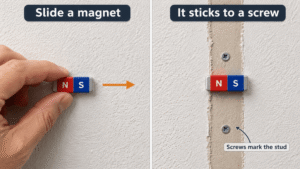
- Use a magnet. A strong magnet slides along the wall and sticks to the drywall screws or nails that fasten the board to the studs.
- Look for clues. Shine a flashlight flat along the wall to see screw dimples or tape seams. Drywall seams usually land on studs. See whether drywall edges need to be on studs and our drywall screw spacing guide.
- Confirm before you commit. Push a thin nail or drill a tiny pilot hole where you think the stud is. Find both edges to locate the center, since a stud is only about 1-1/2 inches wide.
Metal studs: a magnet works here too. Use fasteners made for metal studs, and read the maker’s instructions for heavy loads. See how to hang drywall on metal studs.
Can you hang a TV on drywall anchors?
Short answer: mount a TV into studs.
- A TV is heavy, and it levers on the wall. A full-motion arm pulls hardest on the top fasteners.
- Manufacturers say no to light anchors. E-Z Ancor’s own listing says its Twist-N-Lock anchors are not for mounting televisions or for ceilings. Most TV mounts specify wood studs and lag bolts in their instructions.
- The mount maker’s instructions come first. If they don’t approve anchors, don’t use them.
If no stud is where you need it:
- Use a mount with a wide wall plate that spans two studs.
- Attach a plywood mounting board to the studs, paint it to match, and mount the TV to the board.
- Only if the mount’s instructions allow hollow-wall anchors, use heavy-duty strap or toggle anchors rated far above the combined weight of the TV and the mount, and plan on about one quarter of the ultimate load.
Basic steps for a stud mount:
- Find the studs and mark their centers.
- Check for wiring and pipes.
- Hold the mount’s template against the wall and level it.
- Drill pilot holes into the studs.
- Fasten the plate with the supplied lag bolts, then hang the TV and test it by gently pulling down.
Not sure about the weight? Check the TV’s manual, and add the weight of the mount.
Common mistakes
- Wrong hole size. Too big and the anchor spins; too small and it breaks the paper. Use the size on the package.
- Overtightening. It crushes the gypsum and strips the anchor.
- Ignoring shear vs pull-out. A shelf or arm that sticks out needs a much stronger setup than a flat picture.
- Trusting one anchor. Use more than one point for anything bigger than a light frame, and remember the rating is per job.
- Going by the biggest number on the box. Check whether it’s ultimate or working load, and use about a quarter of the ultimate.
- Wrong thickness. Ratings are for 1/2 inch board. Thinner board holds less.
- Heavy loads from the ceiling. Use joists.
- Using drywall anchors in plaster. E-Z Ancor says its products cannot be used in plaster.
- Not checking behind the wall. Wires and pipes sit where you want to drill.
- Hitting a stud by accident. If your drill hits wood, stop and use a screw directly into the stud instead of an anchor.
Anchor problems and fixes
- The anchor spins: see how to fix a spinning drywall anchor.
- You need to take one out: see how to remove a drywall anchor.
- Can you reuse it? See whether you can reuse drywall anchors.
- You have a leftover hole: see how to patch a hole in drywall. Small anchor holes need only spackle or joint compound.
- The fixture pulled out and tore the paper: the board is damaged around the hole. Patch it, then move the fixture to a stud or a stronger anchor.
- No drill: see how to install a drywall anchor without a drill.
If you’re also installing or replacing drywall, see our beginner’s guide to drywalling a room and our guide to drywall screw sizes.
Products worth a look
Disclosure: this post contains affiliate links. If you buy through them, I may earn a commission at no extra cost to you.
- Medium duty, self-drilling: E-Z Ancor Twist-N-Lock (50 or 75 lb)
- Heavy duty, reusable: Toggler SnapToggle strap toggles, 1/4-20
- Clip-style toggle: Pop Toggle
- Light duty, plastic: ribbed plastic expansion anchors, assorted pack
- Finding studs: a stud finder with live-wire detection
- Mounting: a small level and a strong magnet for finding screws
FAQs
How much weight can drywall anchors hold?
It depends on the type. Plastic expansion anchors are typically rated around 10 to 25 lb, self-drilling anchors around 50 to 75 lb, and heavy strap toggles have ultimate loads of about 265 lb in 1/2 inch drywall. Plan on only about one quarter of an anchor’s ultimate load, and follow the rating on the package.
What is the best anchor for a TV on drywall?
A stud is better than any anchor. TV mounts are designed for wood studs and lag bolts, and E-Z Ancor says its self-drilling anchors are not for televisions. Only use hollow-wall anchors if your mount’s instructions allow them, and choose heavy-duty toggles rated far above the weight.
Can drywall hold a screw by itself?
Only for very light items. A screw driven only into drywall pulls out easily, so use an anchor or a stud for anything with real weight.
Are drywall anchor ratings per anchor or per job?
E-Z Ancor says its ratings are per job, not per anchor, so two 50 lb anchors do not hold 100 lb. Check the maker’s instructions for any anchor you use.
What is the strongest drywall anchor?
Strap toggles such as the Toggler SnapToggle are among the strongest. The 1/4-20 size has an ultimate load of 265 lb in 1/2 inch drywall, and in an independent test one held 180 lb without failing. Follow the maker’s guidance and use about one quarter of the ultimate load.
Can I use drywall anchors in a ceiling?
Avoid hanging heavy items from drywall. E-Z Ancor says its self-drilling anchors are not for ceilings. Use joists, and only use an anchor the maker rates for ceiling use for light items.
Quick recap
- Studs beat anchors for anything heavy, especially TVs.
- Plastic for very light items, self-drilling for medium, and toggles for heavy loads in hollow walls.
- Plan on about one quarter of an anchor’s ultimate load, and remember ratings are per job.
- Check the drywall thickness, hole size and whether the load pulls out or slides down.
- Find studs with a knock test, outlets, a magnet and tape seams.
Got a project you’re not sure about? Leave a comment with what you’re hanging, its weight and your wall, and I’ll point you in the right direction.