
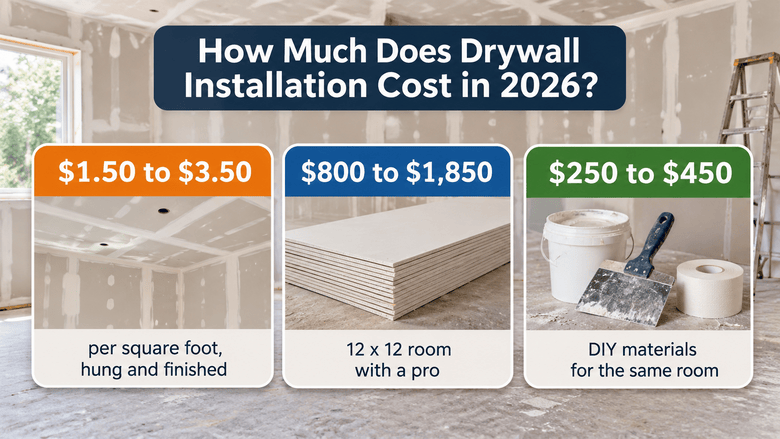
Quick answer: Drywall installation cost typically runs about $1.50 to $3.50 per square foot to hang and finish, depending on finish level, ceiling height and region. A 12 x 12 foot room (about 528 square feet of walls and ceiling) usually works out to roughly $800 to $1,850, and more in high-cost areas.
If you’ve gotten a drywall quote and wondered whether it’s fair, or you’re deciding between doing it yourself and hiring someone, this guide shows where the numbers come from. You’ll see costs per square foot, per sheet and per room, what pushes the price up or down, three worked examples with the math, and how to compare quotes without getting burned.
National cost guides don’t agree with each other, so I use ranges here and say where the sources differ. Your local price will depend on your region and the contractor.
Drywall cost at a glance
| What you’re paying for | Typical cost |
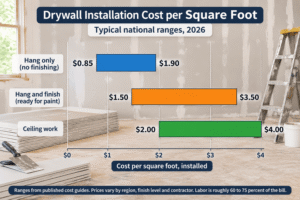
| Hang only (no tape, mud or finish, called Level 0) | About $0.85 to $1.90 per square foot |
| Hang and finish (ready for paint) | About $1.50 to $3.50 per square foot |
| Ceiling work | Often about $2 to $4 per square foot installed |
| Per 4 x 8 sheet, hung and finished | About $48 to $112 (32 square feet x $1.50 to $3.50) |
| Materials only, per 4 x 8 sheet of 1/2 inch | Roughly $10 to $20, more for 5/8 inch or moisture-resistant board |
| A 12 x 12 room (528 square feet) | Roughly $800 to $1,850 |
| Labor share of the bill | Roughly 60 to 75 percent |
Hanging and finishing are usually quoted together. Most guides put the national range at $1.50 to $3.50 per square foot, including materials and labor. Prices in big cities are commonly higher.
What drives the price
Four things move the number most:
- Finish level. The more coats and sanding, the higher the cost. A garage doesn’t need a paint-ready finish, but a living room does. See the next section.
- Ceilings and heights. Ceilings take more labor because the sheets have to be lifted overhead. Ceilings that are 9 or 10 feet or higher often add 10 to 20 percent, and very high or vaulted ceilings cost more. See how to hang drywall on 10-foot walls.
- Thickness and type. 1/2 inch is the standard. 5/8 inch (often used for ceilings and fire-rated walls), moisture-resistant board and soundproof board cost more. See where fire-code drywall is needed and where to use mold-resistant drywall.
- Region and job size. Costs are higher in expensive metro areas. Small jobs often cost more per square foot because contractors set minimums. Some price a minimum of several hours of labor, so a tiny job can cost a lot more than the per-square-foot math suggests.
Smaller factors include room shape (lots of corners and angles), the number of door and window openings, accessibility, and the time of year.
Cost per square foot by finish level
Finish levels (0 to 5) describe how smooth the wall is. Higher levels need more coats of joint compound and more sanding. Read our full finish levels guide.
| Level | What it is | Where it’s used | Cost |
| Level 0 | Hung only, no tape or mud | Temporary or hidden areas | About $0.85 to $1.90 per square foot |
| Levels 1 to 3 | Taped, with one to two coats | Garages, attics, behind tile, heavy texture | Lower than Level 4 |
| Level 4 | Three coats, ready for flat or eggshell paint | Most walls and ceilings in living spaces | About $1.50 to $3.50 per square foot installed |
| Level 5 | Level 4 plus a skim coat over the whole surface | Gloss paint, strong side lighting | A premium on top of Level 4. Ask for it as a separate line. |
Guides don’t agree on exact prices for the in-between levels, so ask your contractor which level they’re quoting. For smooth surfaces and the cost of that final skim coat, see our skim coat guide.
Worked examples: a 12 x 12 room, a basement and a garage
These examples use the national range of $1.50 to $3.50 per square foot installed and the DIY materials range from our beginner’s guide to drywalling a room. Measure your own space with the drywall calculator or read how to measure drywall
Example 1: a 12 x 12 foot room with 8-foot ceilings
- Walls: 48 feet around x 8 feet high = 384 square feet
- Ceiling: 12 x 12 = 144 square feet
- Total: 528 square feet (about 492 after a door and window)
- Pro cost: 528 x $1.50 = $792 up to 528 x $3.50 = $1,848, so roughly $800 to $1,850
- DIY materials: roughly $250 to $450 for about 17 to 19 sheets, screws, tape, mud and corner bead
Example 2: a 20 x 30 foot basement with 8-foot ceilings
- Walls: 100 feet around x 8 feet = 800 square feet
- Ceiling: 20 x 30 = 600 square feet
- Total: 1,400 square feet, or about 1,300 after doors and windows
- Pro cost: 1,300 x $1.50 = $1,950 up to 1,300 x $3.50 = $4,550, so roughly $1,950 to $4,550
- DIY materials: about 45 sheets and 13 gallons of compound, roughly $600 to $1,100
- Watch for: moisture-resistant board in damp basements, framing, insulation and a vapor barrier. See vapor barriers behind drywall. These are not included above.
Example 3: a 20 x 20 foot two-car garage
- Walls: 80 feet around x 8 feet = 640 square feet, minus about 150 for the garage door and a service door = about 490
- Ceiling: 20 x 20 = 400 square feet
- Total: about 890 square feet
- Pro cost: 890 x $1.50 = $1,335 up to 890 x $3.50 = $3,115, so roughly $1,335 to $3,115. Garages often get a lower finish level, which can keep the price toward the low end.
- DIY materials: about 30 sheets, roughly $450 to $800
- Watch for: attached garages often need fire-rated 5/8 inch board. Local code decides. See what drywall to use in a garage.
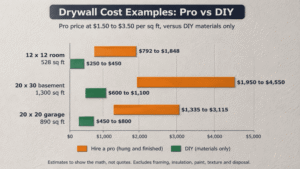
These are estimates to show the math, not quotes. Real prices depend on your region, the finish level and what’s included.
DIY cost vs hiring a pro
Labor is roughly 60 to 75 percent of a professional drywall bill, which is why DIY can save so much. Here is a materials list for a 12 x 12 room:
| Item | Estimated cost |
| 17 to 19 sheets of 1/2 inch drywall | About $170 to $340 |
| Screws (a few pounds) | About $15 to $25 |
| Joint tape | About $5 to $12 |
| Joint compound (5 to 6 gallons) | About $15 to $30 |
| Corner bead | About $0 to $20 |
| Primer | About $15 to $25 |
| Total | About $220 to $455, so roughly $250 to $450 |
Prices vary by store and region, so check local prices. See joint compound types to pick the right mud.
You’ll also need tools: knives, a mud pan, a pole sander, a screw gun and a lift for ceilings. If you don’t own them, add a modest amount for buying or renting.
| DIY | Hire a pro | |
| Cost, 12 x 12 room | About $250 to $450 | About $800 to $1,850 |
| Time | 3 to 5 days, mostly drying time. See how many days it takes. | Often a few days |
| Skill | Finishing takes practice | Smoother, faster finish |
| Best for | Small rooms, garages, lower finish levels | Ceilings, high walls, Level 5, large jobs |
When DIY isn’t worth it: very high ceilings, large projects, Level 5 finishes, or when you don’t have a helper or a lift.
Hidden costs: dumpster, dust control, texture and paint
The per-square-foot price is rarely the whole bill. Ask whether your quote includes:
- Removing old drywall: about $0.50 to $2.50 per square foot for demolition and disposal.
- Dumpster rental: often about $280 to $490 per week for a debris dumpster.
- Texture: about $0.80 to $2.00 per square foot, about $1 to $2 for ceilings. See how to texture with drywall mud.
- Paint and primer: usually a separate service, often around $1 to $2 per square foot for ceilings. See how to prepare drywall for paint.
- Popcorn ceiling removal: about $1 to $2 per square foot, plus asbestos testing. See how to remove a popcorn ceiling.
- Dust control and floor protection: may be billed separately.
- Permits: large jobs may require them, and fees vary by location.
- Repairs behind the wall: new framing, mold, water damage, or asbestos or lead in older homes can add a lot.
Drywall repair costs: small repairs are much cheaper than installation, though most pros charge a minimum visit fee.
- A typical repair project often runs about $200 to $750 in one national guide.
- A single hole patch: see how to patch a hole in drywall.
- Nail pops: see how to fix nail pops.
- Not sure whether to repair or replace? Read our guide on repair vs replace.
How to get and compare quotes
Quotes only mean something if they cover the same work. Follow these steps:
- Get at least three quotes. One quote tells you nothing. Three shows the range.
- Give every contractor the same scope. Room sizes, ceiling height, thickness, finish level, texture, paint and disposal.
- Ask for an itemized quote. Hanging, taping and finishing, texture, paint, disposal and cleanup should be separate lines.
- Compare per square foot, not just the total. Convert each quote so you’re comparing like with like.
- Ask about minimums, deposits and timing. And what happens if they find extra repairs.
- Check license and insurance. Requirements vary by state.
- Look at past work. Ask for photos of finished jobs, ideally in similar lighting.
- Be careful with the lowest bid. A price far below the others may mean skipped coats, a lower finish level, or extras added later.
A quick checklist to send every contractor:
| Question | Why it matters |
| Which finish level are you quoting? | Level 4 and Level 5 are priced very differently |
| Is texture, primer or paint included? | Often not |
| Is disposal and cleanup included? | Dumpsters and dust control can add hundreds |
| Is there a minimum charge? | It can raise small-job prices |
| What’s the timeline, and is a deposit required? | Avoids surprises |
FAQs
How much does drywall installation cost per square foot?
Most guides put drywall installation cost at about $1.50 to $3.50 per square foot to hang and finish, including materials and labor. Hanging alone (no finishing) is about $0.85 to $1.90. Ceilings, high walls, higher finish levels and expensive regions cost more.
How much does it cost to drywall a 12 x 12 room?
A 12 x 12 room has about 528 square feet of walls and ceiling, so a professional job usually costs roughly $800 to $1,850. Doing it yourself typically costs about $250 to $450 in materials.
How much does a sheet of drywall cost installed?
A 4 x 8 sheet covers 32 square feet, so at $1.50 to $3.50 per square foot it works out to roughly $48 to $112 per sheet, hung and finished. The material alone is much less, often about $10 to $20 for a sheet of 1/2 inch.
Is it cheaper to hang drywall yourself?
Yes, usually. Labor is around 60 to 75 percent of a pro’s bill, so DIY can save hundreds or more on a room. The trade-offs are time, tools and the skill it takes to get a smooth finish.
Why do drywall quotes vary so much?
Quotes differ because of finish level, ceiling height, texture, paint, disposal, region and minimum charges. Always ask for an itemized quote that covers the same scope.
Does drywall installation cost include paint and texture?
Usually not. Texture is often an extra $0.80 to $2.00 per square foot, and painting is typically a separate service. Always check what your quote includes.
Quick recap
- Expect about $1.50 to $3.50 per square foot to hang and finish drywall.
- A 12 x 12 room is roughly $800 to $1,850 with a pro, or $250 to $450 in DIY materials.
- Finish level, ceilings, thickness, region and minimum charges move the price most.
- Ask about hidden costs: disposal, texture, paint, dust control and repairs.
- Get three itemized quotes for the same scope before you decide.
Got a quote you’re trying to make sense of? Leave a comment with the room size, finish level and what’s included, and I’ll help you check it.